Established to promote the conservation of the quality of the environment of the area in the watershed of Lake Kanasatka, including the conservation of the natural resources of the land, water, marshland, woodland and open spaces, as well as the plant and animal life therein, and the protection of the water quality of Lake Kanasatka and its tributaries against pollution.
LAKE KANASATKA NEEDS OUR HELP !
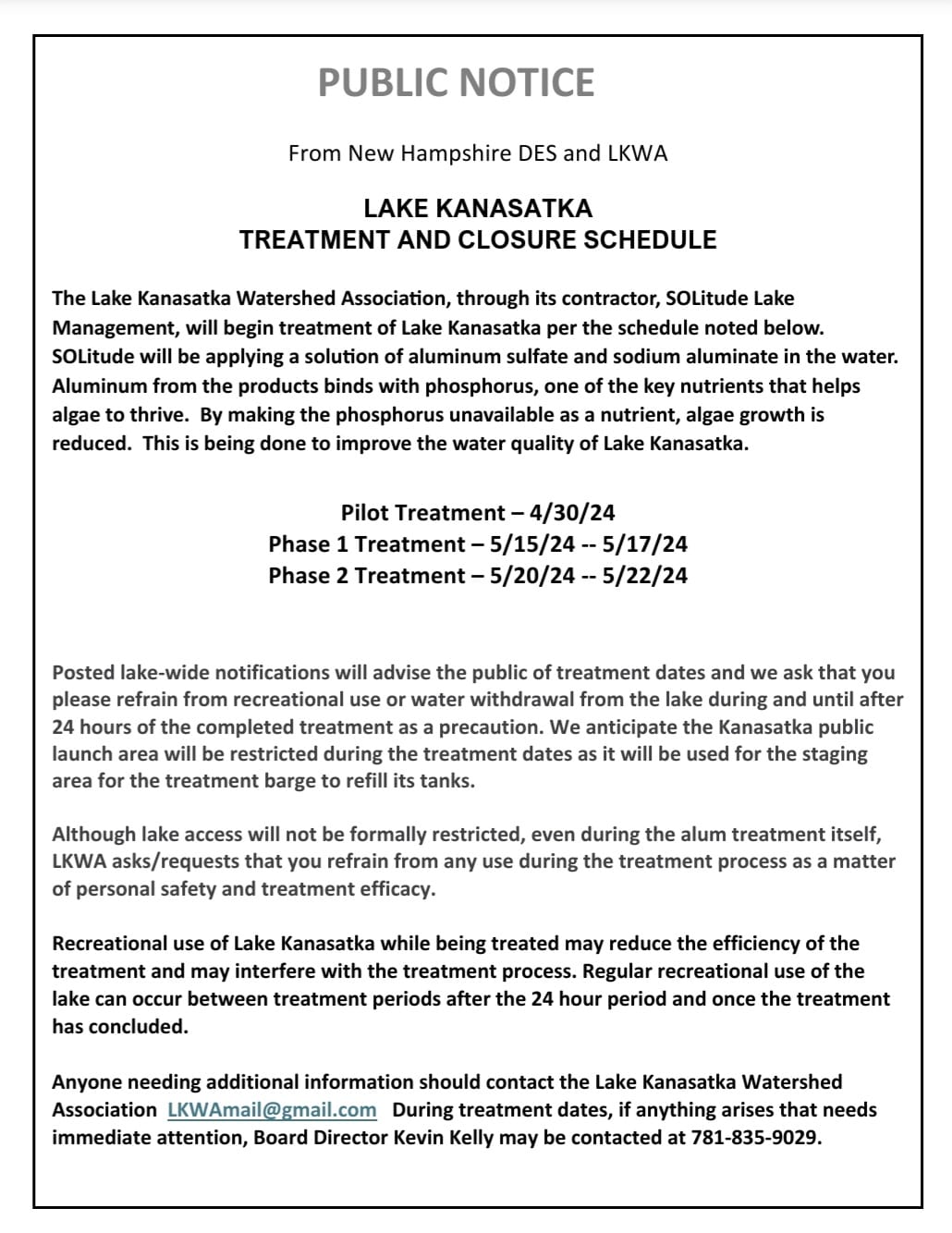
Funding Update! The New Hampshire Department of Environmental Services (NHDES) notified LKWA on 3/15/24 that our Cyanobacteria Mitigation Fund grant application has been selected for a grant award in the amount of $500,000.00.
The grant agreement will be sent to the Governor and the Council meeting on April 10th for review. If approved, their vote will secure the funds for a project start in late April.
This award is 93% of the requested amount. While this is great news, and provides a little breathing room – insuring that the alum treatment will move forward as scheduled in mid-May, we still need all pledged monies to complete the post treatment monitoring process, and cover additional expenses incurred over the last 6 months leading up to the May treatment and for future expenses as outlined below.
In addition to the alum treatment itself, coming in at roughly $500,000, we have incurred expenses related to the treatment process – consultant fees, filing fees, printing, mailing and postage expenses and additional water quality testing costs totaling $54,000~. Water quality monitoring will also be required during treatment and continuing through at least October of 2024. The cost is estimated by FB Environmental to be around $55,000.
Watershed and shoreline site remediation efforts to further reduce stormwater runoff and secure the longevity of the alum treatment is continued and ongoing. This work will include engineering plans for more difficult sites and likely streams, some of which will also involve wetland considerations. Monthly enhanced water quality monitoring for two years post treatment and additional sets of core samples recommended by FB Environmental, as well as continued site visits for calculations of external load reductions are all future expenses for LKWA. Additional funding for these projects must be taken into account as well as financial matching which may be required as a part of any future grants. We are not able to provide specific cost estimates at this time.
If you have not completed your planned donation or wish to make an additional contribution, please do so now.
Send your check to LKWA at PO Box 744, Center Harbor 03226 or use the online payment portal below.